
Personalized Stories for Kids: Making Your Child the Hero
What research says about personalized stories with your child as the hero: word learning, morals, privacy, and a free template to write one at home.
By the MiniMinds team

On this page
- What is a personalized story?
- Do personalized books help children learn new words?
- Can a story with my child as the hero teach values?
- What are the downsides of making your child the hero?
- Is it safe to use my child's name and photo?
- How do I make a personalized story at home?
- What does research say about AI-written personalized stories?
- How does MiniMinds make personalized stories?
- Sources
A personalized story is a story made for one child, with their name, interests or everyday life in it, and often with the child as the hero. Small studies suggest these stories can make shared reading more fun and help young children learn new words, at least in print. They are not a proven way to teach morals, and it helps to talk about the other characters too.
In short
- In a small experiment with 18 preschoolers, children learned new words better from the personalized parts of a print book than from the rest.
- The same research group found no word-learning difference with digital personalized books.
- With personalized books, children talked mostly about themselves, while parents talked more about the other characters.
- Evidence on values is mixed: a child's name alone in a sharing story did not improve sharing, while their photo and name raised sharing right after one reading in 315 children aged 5–6.
- You can make a personalized story at home with a simple template, without a photo, an app or your child's full name.
What is a personalized story?
It is a story shaped around one child: anything from swapping in a name to building the plot around their life, favorite things and worries.
| Type | Example | What studies found |
|---|---|---|
| Name only | "Once upon a time, Ella…" | In one study, no better grasp of the moral, no more sharing |
| Name and photo | Your child's face on the hero | In one trial, it raised sharing right after one reading |
| Personal pages | A page about Ella's cat and favorite food | In print, better word learning in one small study; in digital books, no difference |
| Made together | Your child picks the plot and draws the pictures | The lead researcher calls this key to engagement |
Whatever the type, researchers stress your part in the conversation; our guide to emotional intelligence in children shows how to talk about feelings in stories.
Do personalized books help children learn new words?
In print, one small experiment says yes. With digital books, the same research group found no difference.
In Kucirkova, Messer and Sheehy's 2014 study, 18 children (average age nearly 4) heard a picture book with personalized and non-personalized sections, each hiding new words. At the second and third tests, the children "showed significantly better knowledge about the words that were in the personalized sections." An earlier home study of 7 families with children aged 12 to 33 months found more smiles and laughs with a personalized book than with a matched ordinary one.
Writing in Scientific American, Kucirkova, who led these studies, adds: "we found no difference in children's word learning when we compared digital books that contained personalized and nonpersonalized sections."
Why might it work at all? In a memory experiment with 138 children aged 4 to 6, things linked to the child's own face were remembered better, which the authors explain as "One's own face captures attention." It was a picture task, not a book: a plausible reason, not proof.
Can a story with my child as the hero teach values?
Perhaps a little, in the short term. The evidence is thin and pulls both ways.
- Name only: in Kruse, Faller and Read's 2021 study, putting the child's name into a sharing story "did not encourage greater comprehension or more sharing behavior" than the same story without it.
- Photo and name: in a randomized study by Kotaman and Balcı (2025) with 315 children aged 5 to 6, a sharing story with the child's photo and name raised sticker-sharing more than the same story without them. The plain sharing story also beat a neutral one, so the message mattered too. Sharing was measured once, straight after one reading.
The name-only study measured morals and sharing, not enjoyment or vocabulary, so it does not show that a name is pointless. Be wary of sales pages quoting big percentages for confidence or reading motivation: we could trace none of them to a study. As Kucirkova puts it, "The studies with personalized books are too few for us to know for sure."
What are the downsides of making your child the hero?
The main one: the story can become all about "me". Stories usually invite children into someone else's shoes; personalized ones, Kucirkova writes, "engage young readers through familiarity and children's natural interest in self."
In her studies, children "talked mostly about their own feelings and experiences," while parents "talked more about other story characters, possibly as an attempt to balance the story discussions." A lab study with 26 mothers and their 3- to 4-year-olds stresses "the importance of parents' role in expanding beyond children's focus on self." A 2024 review adds that for social learning, what matters is not familiarity as such but how much of a story is already familiar. One sensible reading: mix the familiar with the new.
Questions that widen the lens:
- "How do you think the fox felt when Ella took the last berry?"
- "What would you have done if you were the dragon?"
- "Who helped Ella? How could she thank them?"
Is it safe to use my child's name and photo?
Think before you upload. Kucirkova warns that "Publishers' use of children's dates of birth or photos, and the periodic reports of misused children's personal data by various companies, behoove researchers to ask ethical questions."
- A first name or nickname is enough. Leave out surname, birth date, school and address.
- Skip the photo; your child can draw the hero instead.
- Before uploading to a service, check whether it keeps photos, who sees the result and whether you can delete it.
- Don't post the finished story publicly with identifying details.
How do I make a personalized story at home?
Choose a hero, a world, a wish and a friend, then let your child fill in some blanks. Kucirkova calls children's and adults' "direct involvement in the books' production" key to "their engagement and conversation around the book."
- Hero: your child, by nickname, or a character like them ("a small fox who also hates socks").
- World: somewhere they love, or somewhere new.
- Wish or problem: if you want a lesson, pick something close to real life (sharing a toy, a first swim) and set it in the story world.
- Friend: a second character with feelings of their own.
- Three tries: two that fail, one that works thanks to something your child is good at.
- Calm ending: home, safe, and one line to repeat.
Fill in the blanks together:
Once upon a time, in ______, there lived ______, who loved ______. One morning, ______ wanted ______, but ______. Along came ______, who was feeling ______. First they tried ______. It didn't work. Then they tried ______. Still no! At last ______ remembered being very good at … That night, back home, ______ whispered: "."
Staple the pages and let your child draw the pictures. For 3–5-year-olds, keep it short and repetitive; from about 6, let your child invent the problem; older children can write it while you illustrate. Then read it aloud together (here is why reading aloud matters), and pause to ask "What happens next?", the story game from our creativity guide.
What does research say about AI-written personalized stories?
Very little so far. We found no peer-reviewed studies of how AI-generated personalized stories affect children; the book studies above used print or digital template books, mostly with small samples. That is a gap in the evidence, not evidence of harm.
Related findings point one way: stay involved. In a lab study of 37 parent–toddler pairs, "Parents and toddlers verbalized less with electronic books, and collaboration was lower." The American Academy of Pediatrics' policy Media and Young Minds says research on interactive media for young children "still remains limited" and stresses parents and children using media together.
How does MiniMinds make personalized stories?
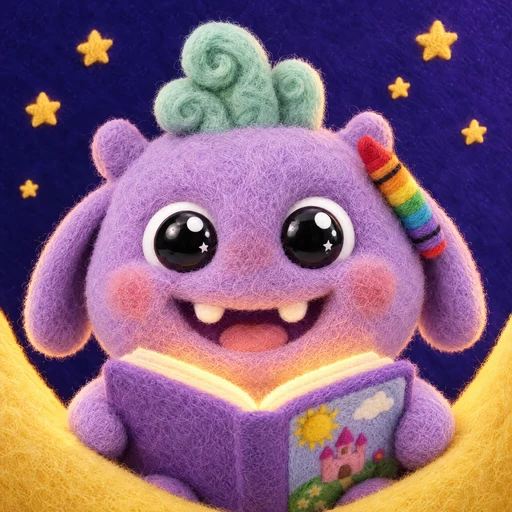
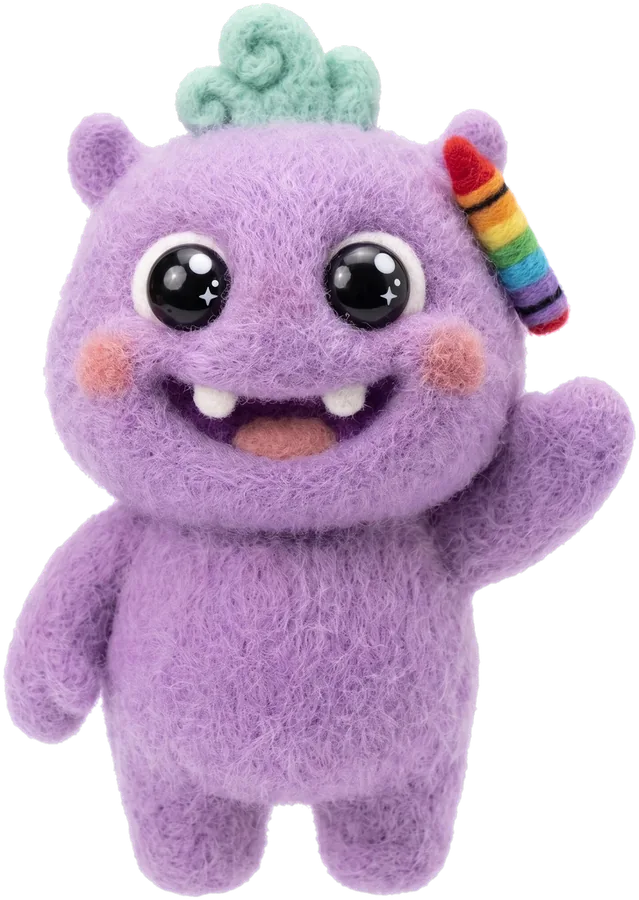
In MiniMinds, your child picks a hero, a world and a lesson. Pofi, the app's storyteller (a small purple felt monster), then writes a brand-new illustrated story with AI in minutes and reads it aloud, each word lighting up as it is spoken. Stories are written for four age bands (3–5, 6–8, 9–11 and 12+), in short, medium or long. You can record each chapter once in your own voice and choose "My voice" in the reader. As the research suggests, read it together and ask about the other characters. Thousands of free stories families have shared are in our library, including stories about kindness and sharing.
Sources
- Kucirkova, Messer & Sheehy (2014). Reading personalized books with preschool children enhances their word acquisition. First Language. link
- Kucirkova, Messer & Whitelock (2013). Parents reading with their toddlers: The role of personalization in book engagement. Journal of Early Childhood Literacy. link
- Kucirkova (2021). The Educational Power—and the Limits—of Personalized Children's Books. Scientific American. link
- Andrews, Murphy & Dunbar (2020). Self-referent encoding facilitates memory binding in young children. Journal of Experimental Child Psychology. link
- Kruse, Faller & Read (2021). Can Reading Personalized Storybooks to Children Increase Their Prosocial Behavior? Early Childhood Education Journal. link
- Kotaman & Balcı (2025). The Impact of Personalized Storybooks on Children's Altruistic Sharing Behavior. Early Childhood Education Journal. link
- Kucirkova et al. (2020). An empirical investigation of parent-child shared reading of digital personalized books. International Journal of Educational Research. link
- Kucirkova & Ciesielska (2024). The Distance Between the Story Character and the Reader. Reading Psychology. link
- Munzer et al. (2019). Differences in Parent-Toddler Interactions With Electronic Versus Print Books. Pediatrics. link
- American Academy of Pediatrics (2016). Media and Young Minds. Pediatrics. link

Part of the guide
Emotional Intelligence in Children: A Parent's Guide by Age