
Bedtime Stories by Age: How to Choose the Right One, From 3 to 12+
How long a bedtime story should be, what calms and what excites, and what suits ages 3–5, 6–8, 9–11 and 12+, with what research does and doesn't show.
By the MiniMinds team

On this page
- How long should a bedtime story be?
- What makes a bedtime story calming, not exciting?
- Is it OK to read the same story every night?
- What are good bedtime stories for 3–5-year-olds?
- What bedtime stories suit 6–8-year-olds?
- What should 9–11-year-olds read at bedtime?
- Should you still read to a 12-year-old?
- Which stories help with fears and big changes?
- How does MiniMinds match stories to age?
- Sources
The right bedtime story for your child's age is one that fits the time you have, ends calmly, and matches what your child can follow and enjoy. Research gives only a few fixed points: the American Academy of Pediatrics suggests 10–20 minutes of books at ages 2–3 and 20–30 minutes for preschoolers. The age-by-age advice below is practical rule of thumb, labeled as such.
In short
- The American Academy of Pediatrics (AAP) suggests 10–20 minutes of shared books at bedtime for 2–3-year-olds and 20–30 minutes for preschoolers; no study sets an ideal length for older children.
- Calm beats exciting before sleep: the AAP warns active play can make a child too excited to sleep, and the NHS says too much stimulation before bed can wake a child up again.
- Rereading favorites helps: in one small study, 3-year-olds learned new words from stories only when they heard the same stories repeatedly.
- Night-time fears are common: 73.3% of 176 children aged 4–12 reported them in one study, and parents underestimated how often.
How long should a bedtime story be?
Only the youngest ages have an official figure, and it covers book time, not one story. For older children no research sets a length or word count, so plan in minutes.
The AAP suggests setting aside 10–20 minutes for books with 2- and 3-year-olds and 20–30 minutes with preschoolers, "with the TV off", and using book-sharing "to calm and comfort your child". That's the book part of a wider bedtime routine. The AAP's read-aloud tips add: "You don't have to finish a story if your child loses interest."
| Age | What guidance says | Rule of thumb (not research) | Themes that tend to work |
|---|---|---|---|
| 3–5 | AAP: 10–20 min of books at 2–3, 20–30 min for preschoolers | Two or three short picture books, or one favorite twice | Animals, family, bedtime itself |
| 6–8 | No official figure | A long picture book or one short chapter, 10–15 min | Friendship, school, funny mishaps |
| 9–11 | No official figure | One chapter, 15–20 min, then lights out | Adventure series, gentle mysteries |
| 12+ | AAP: screens off an hour before bed | Their own book on paper, 15–30 min | Whatever they love |
What makes a bedtime story calming, not exciting?
A calming story is predictable, unhurried, and ends with everyone safe; an exciting one builds suspense and stops on a cliff.
The AAP warns that "active play may make your child too excited to sleep", and the NHS says too much stimulation before bed "can wake your child up again", suggesting calmer activities "like reading". Songs work the same way (see our post on lullabies and bedtime songs).
The clearest evidence on content is about screens, not books. In a study of 3–5-year-olds, evening media use and violent content were linked with more sleep problems; nonviolent daytime media was not. Whether frightening books do the same hasn't been tested.
What tends to settle a child:
- a familiar setting and one small problem that gets solved;
- refrains your child can predict or join in;
- a quiet last page, and your voice slowing down toward it.
What tends to wind them up: chases, monsters, sudden surprises, stopping mid-danger.
Is it OK to read the same story every night?
Yes. Rereading is normal, and for young children it seems to help them learn.
In a small experiment, 3-year-olds heard specially written storybooks three times in a week. Those who heard the same stories repeatedly learned the new words in them; those who heard different stories "failed to learn any of the new words". The AAP's page for 2–3-year-olds says: "Enjoy sharing the same book over and over and over again!" Its read-aloud tips add: "Let your child choose the book even if it means reading the same book over and over."
Tired of it? Trade: the favorite, then one new one.
What are good bedtime stories for 3–5-year-olds?
Short picture books with a simple plot, lots of repetition and a cozy ending suit most 3–5-year-olds.
On format, a brain-imaging study of 27 preschoolers compared five-minute stories in audio, illustrated and animated versions. Pictures seemed to ease the strain on the language network compared with audio alone; animation reduced connections between brain networks. It was small and didn't measure sleep or learning, so audio stories aren't "bad".
Rule of thumb: animals, family and everyday adventures work well, with mild villains. In one study of 176 children, night fears were already common at 4–6.
What bedtime stories suit 6–8-year-olds?
Many 6–8-year-olds are ready for early chapter books read over several nights, and still benefit from hearing you read. Night fears grow more frequent now, so choose villains with care.
The same study found them "even more frequent" at 7–9. Reading aloud also fades here: in Scholastic's 2019 survey, read-aloud peaked at age five, and parents most often said they stopped because their child could read alone. (Scholastic sells books, so treat it as industry data.) The AAP is clear: "don't stop reading aloud to them once they have learned to read for themselves."
Rule of thumb: one chapter a night, a series with familiar characters, and turns reading a page each. More ideas are in our guide to building a reading habit.
What should 9–11-year-olds read at bedtime?
A chapter of a printed book, chosen by your child, is a good default at 9–11, read together or alone with a clear lights-out time.
In a survey of 2,334 Canadian fifth-graders, those who rarely read a printed book in the hour before sleep slept less and worse, and using a phone, computer or TV in the bedroom in that hour went with roughly 8–11 fewer minutes of sleep. A survey shows a link, not cause.
In a study of 511 children and teens aged 8–16, 64.2% reported them, fear of intruders was the most common, and children reported them far more than adolescents (79.4% vs 48.8%). Rule of thumb: skip the break-in thriller at bedtime.
Should you still read to a 12-year-old?
Yes, if they want it. At 12+ the choice is theirs: offer to read or share a book, and protect their own reading time.
The AAP's sleep guidance notes that sleep-wake cycles "shift up to two hours later at the start of puberty", and recommends keeping screens out of bedrooms and off at least an hour before bed. A paper book, and the phone charging elsewhere, is the simplest setup. Offer; don't impose.
Which stories help with fears and big changes?
A gentle story in which a character faces something similar and comes out fine can open a conversation. No study we found tests which stories help, so this is practical advice.
In the study of 176 children, almost 80% put their fear down to frightening things they'd heard or seen, and parents underestimated how often it happened.
- Ask first: "Is anything worrying you at night?"
- New sibling, new school, a move: read the story about it in daylight; at bedtime, an old favorite may comfort more.
- Let them change the ending, so the scary part ends safely.
- After a bad dream, the AAP advises comforting your child, letting them tell you about it, and reminding them "dreams are not real". Nightmares tend to peak between 3 and 12.
If fears or nightmares are frequent, keep your child from sleeping, or spill into the day, talk to your pediatrician.
How does MiniMinds match stories to age?
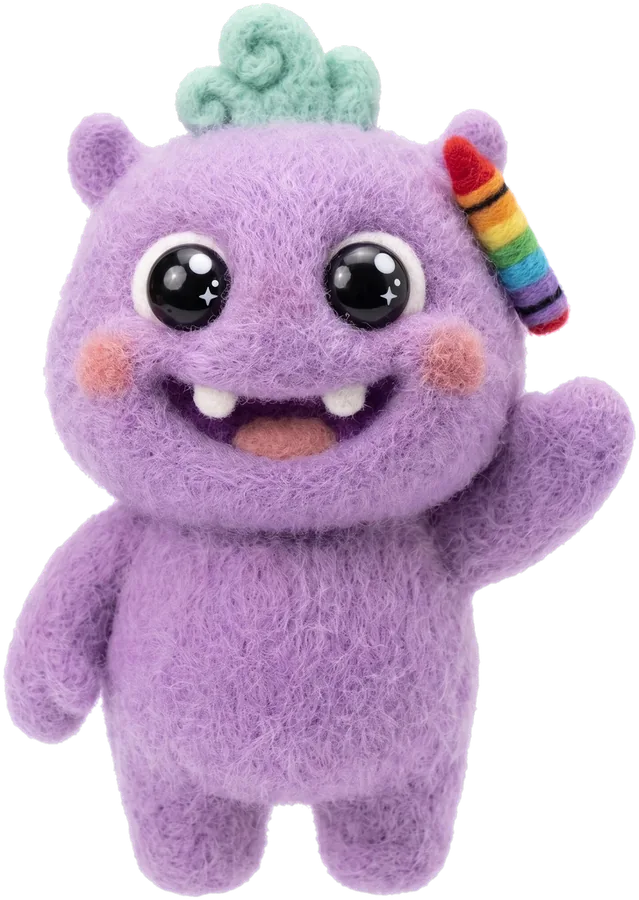
In MiniMinds, a child picks a hero, a world and a lesson, and Pofi, its storyteller (a small purple felt monster), writes a new illustrated story for one of four age bands, 3–5, 6–8, 9–11 or 12+, in a short, medium or long version, and reads it aloud. You can also record the chapters in your own voice. It's a screen, so the advice above applies; a grown-up sets a per-session time limit. The free library sorts stories families shared by age: 3–5, 6–8, 9–11 and 12 and up.
Sources
- American Academy of Pediatrics (2021). How to Share Books with Children 2 and 3 Years Old. HealthyChildren.org. link
- American Academy of Pediatrics (2013). How to Share Books with Your Preschooler. HealthyChildren.org. link
- American Academy of Pediatrics (2018). Tips to Help Your Child Enjoy Reading Aloud. HealthyChildren.org. link
- American Academy of Pediatrics (2022). Toddler Bedtime Trouble: 7 Tips for Parents. HealthyChildren.org. link
- NHS (2025). Helping your baby to sleep. NHS. link
- Garrison MM, Liekweg K, Christakis DA (2011). Media use and child sleep: the impact of content, timing, and environment. Pediatrics. link
- Horst JS, Parsons KL, Bryan NM (2011). Get the story straight: contextual repetition promotes word learning from storybooks. Frontiers in Psychology. link
- Hutton JS, et al. (2020). Differences in functional brain network connectivity during stories presented in audio, illustrated, and animated format in preschool-age children. Brain Imaging and Behavior. link
- Muris P, et al. (2001). Children's nighttime fears: parent-child ratings of frequency, content, origins, coping behaviors and severity. Behaviour Research and Therapy. link
- Scholastic (2019). The Rise of Read-Aloud. Kids & Family Reading Report, 7th edition. link
- Dube N, et al. (2017). The use of entertainment and communication technologies before sleep could affect sleep and weight status: a population-based study among children. International Journal of Behavioral Nutrition and Physical Activity. link
- Gordon J, et al. (2007). Nighttime fears of children and adolescents: frequency, content, severity, harm expectations, disclosure, and coping behaviours. Behaviour Research and Therapy. link
- American Academy of Pediatrics (2026). Healthy Sleep Habits: How Many Hours Does Your Child Need? HealthyChildren.org. link
- American Academy of Pediatrics (2023). Nightmares, Night Terrors & Sleepwalking in Children: How Parents Can Help. HealthyChildren.org. link

Part of the guide
Bedtime Routine for Kids: What Works and Where the Story Fits